

Notes on Notes from Below
A supportive, but critical response to Notes from Below’s latest issue The Political Leap: Communist Strategy Today (#19).

Issue 19 - The Political Leap: Communist Strategy Today
As someone who walked out of school with few qualifications, some of the most profound and important experiences of my life have been when I've experienced an evolution in intellectual thought or political consciousness. On many occasions, I've been scanning my shelves for the “right” book to read and I’ve come across a text that I haven’t engaged with for some time. I’ll draw it down, turn it in my hands and I’ll stay there with it for a while because it is imbued with a moment. It stirs something deep in me and brings forth a memory to the front of my mindseye. A moment of personal evolution. It’s fantastic words or ideas once inspired something in me. Something that could be considered to others, maybe, as a minor almost trivial thought. But which, in the context of my development - my life - was a moment of great import. A moment when I realised something about myself, the world, or the people around me. It had implications for everything that I did after then.
I had such a moment when I read through Notes from Below’s (NfB) latest issue. And it wasn’t because I realised anything new about the world, myself, or the people around me. It was because I realised that there are people who know the things that I know, feel the same way about it, and look to approach it in a similar way. A serious way. And that was the moment: understated. One of profound simplicity. It said to me: You are not alone. And that is enough, sometimes, to keep your head up in this moment of extreme atomisation.

On the level
It has always been clear that NfB are on the level. With their scientific focus on class composition, the themes under inquiry, their mode of analysis, and their mature voice, they’ve always presented themselves as being a serious outfit. Like many others, though, their perspective has often been accompanied by an ambiguous radical politic, which has generally been on brand with the rest of the Amorphous Blob of British Left. So, their ‘coming out as communist’ is a welcome one and hopefully represents a broader and deeper maturation of the British Left post-Corbyn.
Situated in the context of their project on class composition, and against the backdrop of a breaking-down Britain, Issue 19 provides sharp analysis of the state of the Labour movement, presenting all of the challenges and all of the tasks. And it is easy on the reader. It’s not at all Marxoid. Throughout - and especially in the editorial - they present quite complex ideas through beautifully simple writing in a sincere and thoughtful way. There are many, many fine and enviable things about the Issue, which I do my best to speak to in the Appendix below.
Note: I have attempted to hone in on overall arguments or themes principally (but not solely) made in the introduction and editorial. Where I am specifically responding to a piece, I try to reference it.
Technical, social and political
At the heart of NfB’s project is a very excellent and useful theory of composition, which one of the most basic premises, according to them, is that changes in the shape of capitalist social relations must lead to changes in the political expression of the working class. This forms the bedrock of their political perspective and method of inquiry, as well as a material relation of three parts:
‘[T]he first is the organisation of labour-power into a working class (technical composition); the second is the organisation of the working class into a class society (social composition); the third is the self-organisation of the working class into a force for class struggle (political composition)1.
It is evident that this theory of composition is a seriously useful innovation and device for materialist analysis1. As a matter of course, the three elements (technical, social and political) provide an essential framework for Marxian analysis, and could also be applied or adapted to provide valuable insights into so many other different areas of social life. But NfB are not just concerned with inquiry. They say that the ‘point of inquiry is always to use the process and the knowledge produced to politically organise as workers.’
This reminds me of a certain quote which has had some mileage over the years, and speaks to the very “essence” of our political project: ‘Philosophers have only ever interpreted the world. The point is to change it.’2 The general sentiment behind this is something that I’ve always had sympathy for. My Dad is an engineer and whilst he’s always been supportive of my academic or intellectual endeavours, he’s always been quite insistent that anything I’ve learnt must have some “practical application”. Our tradition is often accused of being too concerned with theory, often unfairly, but there is a truth there too.
A number of times in the editorial, the collective reflect on their development as a project, which you’d expect, but often to interrogate or re-affirm their principle ambitions: ‘Then, as now, we drew our methods and theory from a broad Marxist tradition that seeks to understand and change the world from the worker’s point of view.’ And this has not been in vain. NfB can say ‘with much greater confidence that we understand the broad outlines of the situation facing the working class in Britain.’
Challenges > tasks > ?
The situation facing the working class in Britain today is stark, and the challenges for Marxists are - despite the seismic shifts in world order - the very same as the ones that have plagued us since the 1960s. We must carve out a path and advance the cause without falling into traps of the past. Organisationally, as NfB suggests, vanguardism, electoralism and syndicalism, are such traps. All have their ‘distinct shortcomings’. The pursuance of any and all has us frozen in a sort of purgatory, locked in a feedback loop of comfortable, unchallenging, but ultimately useless habits. Any political project which accepts this reality and sincerely attempts to find a new way through the wilderness of the early 21st century, navigating by the blinding stars of communist political practice, deserves our sincere respect.
NfB are attempting to carve out such a path and advance the cause through their three practices laid out in the Issue’s concluding editorial ‘The Organisational Question’. They say that through practicing a politics of inquiry, mass and democratic forms of organising, and developing a shared political space, they hope to ‘begin to outline a shared starting point for building a coherent communist project with an orientation towards workplace organising.’ And in counter to the Sect form, which has dominated British Communist politics for at least the last four decades, they insist that ‘organisational form should always follow politics, not the other way around.’ Crucially, there is no call for further Left homogeneity either. Actually, quite the opposite. Now, as before, they ‘[a]re trying to orientate away from the existing “Left” and rebuild a politics that starts from workers’ changing experience of capitalism.’ And they are under no illusions about the fact that ‘it is too early to provide an exact blueprint for a new political organisation at this stage,’ or, that inquiry is but ‘one method’ in ’understanding changing class composition as a critical part of a project of collective self-emancipation’.
In order to respond to the situation facing the working class today, NfB says we need a new organisation for militant communists. This ambition flows from a generalist definition of communist and communism that they are also working towards realising:
‘By communist, we mean a revolutionary politics based on the self-emancipation of the working class. Instead of arguing about which flavour or brand of Communism, we want to practically work towards a form of politics and organisation that can equip us for the task ahead.’
Though, it’s not to say that they don’t speak from a particular perspective. They liberally quote Hal Draper, advocate for rank-and-file networks (with little to no mention of ‘popular frontism’) and write against ‘Stalinism’. To do so is no great political leap, of course, with their commitment to ‘from below’ socialist politics.
? > organisation > politics
The collective don’t present their political solution as anything but a preference, though it is in response to conditions and a sober assessment of our class forces: ‘We face a collapsing institutional left, a cost-of-living crisis, impending climate chaos, and high levels of industrial action - albeit with relatively low rank-and-file organisational capacity.’ And whilst “[t]here have been flashpoints in recent struggles and moments of the assertion of rank-and-file power [...] most communist organising is now fractured and isolated.’
The challenges and the tasks have never been clearer3. And it’s a challenge for me to not quote NfB at length as they identify all of the key things incl. Corbynism being a catalyst for this ‘from below’ moment, the sect-form being a blocker (and born of a real state of dis-organisation), and the need to extend the workplace struggle to other areas of social life, to name but a few. They’ve got their finger on the pulse. And, in fact, they spoke to so many of my own personal experiences or observations that sometimes it actually felt like they were speaking directly to me4. And probably not just me, but every Communist in the Western hemisphere. It is clear that to unite and extend the struggles, to overcome the sect form, the inherent limitations imposed by syndicalism5, electoralism, or anything else, and live up to the historic struggle which the climate crisis represents: We need a new communist organisation.
The moment demands it. I admire NfB’s motivation to produce an issue which distinctly looks at organisation and agitation because they believe that ‘disorganisation is no longer an option given the accelerating crises of our moment.’ I am united with them by the “desire for a revolution”. No one yearns for a vibrant revolutionary communist organisation more than me. But there was a time when I yearned for my members to take industrial action. I wanted them to take it so that they could experience and feel their power. To elevate their consciousness, raise their confidence and open up new possibilities. Because it has been clear to nearly every lower or mid-ranking colleague of mine that they have needed a pay rise for over a decade. But until the right events - in the workplace and in wider society - had transpired, they would not ballot the way that I wanted them to. We couldn’t even make the threshold. They would not take up preliminary structures of organisation or patterns of militancy to force struggles over pay. No matter the level of crises. No matter the agitation. It was only when a series of events (external and internal), in a particular sequence, combined with the agency of a layer of workers in my workplace to give us the mandate for industrial action over pay, that we struck.
The above example is not very detailed. The reader has to take it in good faith that I’m not misrepresenting the events and my very broad generalisations have some basis in reality. It is also of a very specific, “Economistic” nature. Of course, the issue of political organisation has a totally different character; a more complex and nuanced, or, a cloudier composition. But even in this scenario which I present above, it is not enough to boil the organisational (read ‘party’6) form down to sophistication and political intent. This is not all that it comprises of.
I can see how that could happen. As I believe that NfB’s theory of composition acts as a substitute for a fuller mode of political thought, which over-emphasises class struggle from quite a subjective standpoint7. It is, of course, the correct starting point for any project of inquiry, but as a political theory, if not moderated by a more objective perspective, it could lead to errors which are analogous to the worst “identitarian” aspects of the Black Lives Matter and Me Too movements8. Of course, subjective accounts are evidently crucial to understanding oppression under capitalism, ‘at work we confront the contradictions of capitalism most clearly, but it is also where we can find our leverage’. No single individual’s experience gives us the systemic critique we need to overcome capitalism. It is a reason why the Marxian project has always been inter-disciplinary. High-level conceptual, ostensibly “objective” analysis, or abstractions of class, state and the economy etc. are essential9. From the editorial, or any of the articles in the Issue, it is difficult to know how engagement with current discussions on these standpoints will be approached or relate to this project.
In the event that my position is misinterpreted: I am not trying to police NfB. This is not a call for them to “pick a side”, a school, a tendency or any implied philosophical, economic or political perspective reflected (consciously or unconsciously) in my own work. After all, I am myself sympathetic to their perspective. It is an observation that NfB, like most on the communist Left, limit their conceptual scope and do not give treatment to communist organisation from a ‘systemic’ perspective10, which is vitally needed for a strategy. This forms an underlying logic which appears to be rooted in the hyper-subjective viewpoint that they take and I think is expressed elsewhere too. For instance, the only international perspectives in this issue are from the Anglosphere11, yet there will be a commonly held understanding that many of the materials we use to produce commodities, or even the commodities themselves, are appropriated from or produced in nations in the Global South. In other words: production, supply chains and therefore capital, is global. Systemic. Why isn’t our conceptual framework for approaching organisation? I have faith that NfB will approach their inquiry in this manner, but why it is not overtly worked through, especially its quite distinct relationship to the three practices, doesn’t make sense to me at all, actually, because Issue 18 Seeds of Struggle: Food in a Time of Crisis does it all.
It is true when NfB say that they believe that interest is resurgent in “from below” politics. Also, that they have developed a decent understanding of class composition in Britain today, but I’m not sure if they’ve sufficiently articulated the wider system (or their vision of it) that the class is in relation to. They touch on the fringes of a critique in places, and the subtext of some of the ideas and the quotes they select to fortify their approach inevitably cultivates a ‘brand and flavour’ of communism. And that is not a problem. I have little sectarian impulse. No grievance at all with these Ultra Leftist Adventurists! It is more, for me, that this limits our conceptual framework for organisation and does not at all deviate or break from patterns of sect practice. I want to be clear that NfB do not treat the words of Draper or Lenin et al as canon, but in their totality, the positions taken inevitably lead to a reductive narrowing of political vision, and the endpoint is a pretty orthodox or typical position for contemporary “Left of Centre Communists” (but with the addition of a novel analytical tool)12. More generally, though, taking the words of Hal Draper, or anyone else as ‘the last word’ on any issue is highly problematic and an enduring trend of the decrepit relic of the 20th century, the Stalinism vs Trotskyism paradigm.
A new type of organisation
When reflecting on this issue, I happened upon the below quote from ex-Marxist materialist ethicist Alisdair MacIntyre13:
“The danger to the non-Marxist Left is that lack of theory leaves its discussions blind and formless; the danger to the Marxist Left is that it tends to treat theory as something finished and final, and so the inherited formulae can become a substitute for thought.”14
Somehow, NfB find themselves straddling both positions. On the one hand, the Issue says, “we need to re-imagine everything”, but out of the side of its mouth it says: “All this other stuff is off the table”. To be clear: my personal political preference is for mass democratic ‘from below’ forms of socialism, and my reading of the conditions is that there is a resurgent interest in ‘from below’ politics, but as true as these facts are, it has no bearing on whether a ‘socialism from below’ is correct or adequate for this moment. But this is not my main gripe. Although it is related. It is that, in my opinion, the overall approach is premature. The main thing that NfB evidence and so adequately describes is that there is a new moment for the workers and Marxist movements. But this is distinctly different from us seeing the right conditions to make useful theories about the next party form15. We cannot put the cart before the horse, or we are doomed to repeat some form of the sect. Whether the institution is a “publication” or “organisational”. No matter how extreme the crisis is, or how earnest our endeavours are.
In the words of one NfB editor, “we are, therefore, in many ways, called upon to start again.”16 I think that the break this represents also includes us taking our eyes off the wavering oasis of the next party form and focusing on putting one good foot forward instead. It’s not that it shouldn’t be an objective, it absolutely should be. The party form is the place where everything should come together: the thriving cultured nexus of disciplines and struggles. But I don’t see how this will come about without building aggregate institutional forces of class power17. The next form could very much look like the old forms i.e. the vanguard party, but the social forces are not currently there to give it any true basis18. As suggested by NfB’s third practice of ‘developing a shared political space’, the material spatial realities that capital has corralled us into are also intrinsic to the political possibilities and the organisational forms we are able to conjure. A major task is to do what we can with the space afforded, take back, and then go beyond. Institutions are space. And it is clear that we have little institutional space to use for maneuver. Not only this, but the institutional forms we have at our disposal are not sufficient. They may achieve odd wins, but not routinely, and are not sufficiently large or sophisticated enough to fight back against the ruling class. Much like our theories on party forms, many of these organisations are also shaped by the specific conditions of the 19th and 20th centuries. Can we really say that UCU, UNISON, Unite, the IWW, or IWGB are really up to the task? The mainstream unions are dominated by the bureaucracies and the syndicalist forms have their moments, but they are not mass organisations. Further, the character of the recent strikes have been purely economic19, mostly defensive in the public sector, and not at the point of production20. As for community or social struggle organisations, such as Acorn, they have their “distinct shortcomings” too. So I regret to say that in Issue 19 I do not think that we have the conceptual basis for anything else other than a new type of economic organisation. Which is not to say that organisations of this type are not desperately needed. They are.
We might think that it should be the other way around because the moment and the future appears so dark. It is totally without precedent. Never before has the world been in such a total state of movement and chaos. It is inferiorising. But also breathtakingly awe inspiring. Like standing before a black storm amassing on the horizon, with electricity ripping through the air and your hair blowing about across your face. It calls for a reaction: A mass revolutionary party to combine the struggles. To act as a counterweight, against a world that is totally out of kilter and on a bad trajectory. But such an organisation has never existed before mass economic organisations of class power. And as evidenced by the Palestine Solidarity Movement, whilst the struggles can be combined and be truly international, they are not coordinated and are united on purely moral grounds; nothing is yet sufficient to meaningfully test the might of global imperialism. We have to accept the conditions as they are, not what we want them to be.
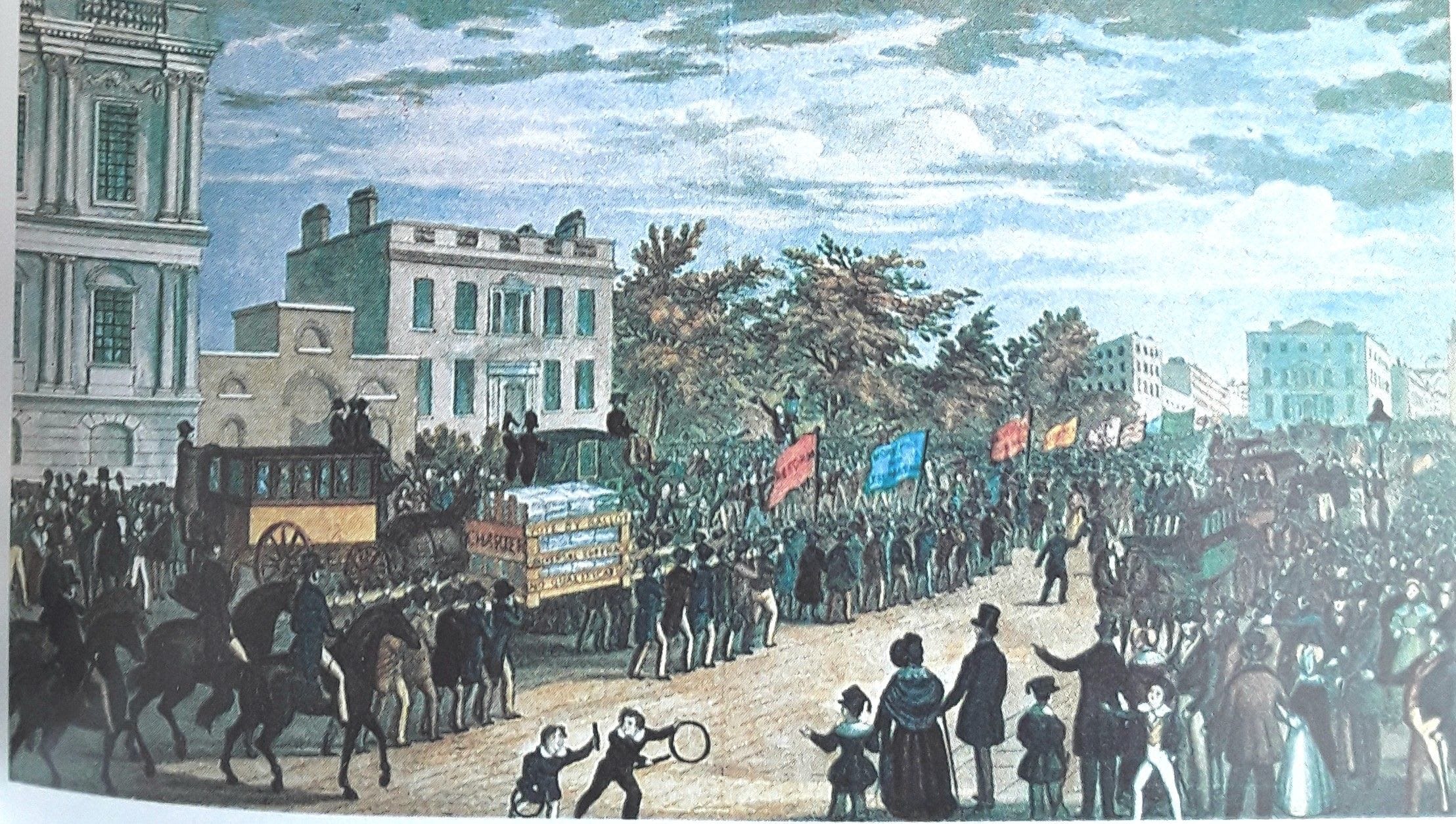
We also have an implicit teleological bias in our thinking; baked into our politics is a concept of social “progression”. A vulgar, but perfectly understandable reading of Marx suggests that Capitalism will seamlessly morph into the coming communist epoch. We just have to wait. Further, still, as a generation we have inherited a century of sectarianism and so we have many blind spots. A sizeable layer of British Gen X and Millennial Marxists came up through Marxist-Leninist sects, who will typically omit figures or events from key periods, to fit a skewed narrative and demonstrate the superiority of their particular tendency. Thus, there are certain 20th century theorists - generally our political parents or grandparents - who are the ones we reach for when trying to understand our moment. We think that their concepts are the most relevant, often because they were successful or the most recent, and therefore must have surely superseded thinkers of an earlier type. Because of our education, we also tend to have a familiarity with them due to a specific presentation of history. But I suggest that at this moment, we have all of our historical reference points all wrong. No doubt, there is much wisdom in the words of Draper and Lenin which can be applied; but whilst capitalist imperialism is in a mature state, working class organisation is not. In our context, the conditions for the working class are more akin to those in the 19th century i.e. we perhaps have more to learn from the experiences of the Chartists21 and the First International, than we do the Bolsheviks or the ComIntern. As suggested then too, any theory also requires an historical analysis.
Rather than a ‘communist organisation with an orientation to workplaces’ then, instead, what is needed is ‘workplace and community organisation(s) with an orientation towards Communism’. Once we have built them up, we can then think more concretely about convergence.
Our moment: The Moment
I appreciate that I am asking NfB to do things that they think they shouldn’t do or don’t want to do. After all, they have an approach, and one they have continually refined and re-committed to. And whilst there are some serious innovations in their method, it also has a bit of the ‘this time it’ll work’ about it. The below quote is from The Merseyside Socialist Research Group, from January 1980.
“Our conclusions are tentative. We have no manifesto. But it is up to all of us who bear the brunt of policies that put profit before people, to develop an alternative strategy. This will involve new forms of organisation and struggle. We will be in a better position to create the future if we understand the past. It is our hope that this book goes some way towards such an understanding.”22
This sounds familiar, at least in sincerity and intent. Yet in the 40+ years since this statement was published, I’m not sure if we’re any nearer to reaching or surpassing such an understanding. In fact, the working class and its institutions are in an even more degraded state than then: ‘Working class institutions are disappearing, and communities are becoming more fractured and transient.’ It goes without saying that ‘[a]ll of these throw up new challenges for collectively organising.’ But as NfB say, these conditions come pregnant with possibilities, or, ‘alive with opportunities’ too23. So nothing should stop them from getting on with the job either. After all, we do not have the luxury of leisurely meditations. Although, I would encourage the collective to adjust the scope of their method. For instance, consider internationalism as a distinct aspect of their practices, and signal how they will institutionally engage in wider Marxian discourse24. Further, we can be pursuant of building aggregate institutional class power and uncovering the next form at the same time, but I put a different emphasis on the immediacy of the political organisational form as a practical, achievable objective25, and invert the two main compositional elements26.
Finally, this is really quite a trivial point, but I can’t help but take issue with NfB’s statement that: ‘Unlike some political organisations of the past, those of us who consider ourselves revolutionaries today have no plan to follow. There is no one we can ask, no one who can tell us what to do.’ This is a somewhat romantic notion and reading of history. Even when all of the working class were organised into mass unions, when they were conscious and on the move, the future was opaque for revolutionaries. The decisions taken were often based on almost criminally naive misunderstandings. There was no plan to follow. Then, as now, there were elder revolutionists with bad politics and good intentions, as well as plenty of false prophets too. Ultimately, all of the paths presented and taken were blind alleys, and they all led here to this moment. So now - as before - we have nothing else to do but step out into the unknown. Whether it's a leap or a limp remains to be seen, but either way, it’s a start.
Note: I am always ready to be proven wrong and challenged, providing any discussion is approached in good faith and in a comradely, non-sectarian manner. You can @ me on X @TheMassLine1. To read more about how I approach my writing, click here.
Annex
Syndicalism and the New Limits of Trade Unions
An excellent piece, which comprehensively lays out the trade union context and how we must approach it as Marxists. As I said above, it’s quite frustrating because I’ve been working on a piece which is substantially identical to this, at least in its primary theoretical assertion. It is very well executed though and I have great admiration for it and the (MASSIVE) Marxian brains behind it.
It is not just Left militants blending into the organised workforce, devoid of political work, which is driving the syndicalist trend. The effect of big tent broad left coalitions in the mainstream unions has created almost de-facto member orgs (limited parties) in the unions (along with rank-and-file networks which is a more useful, but still failed form). This has created an “informal” syndicalism. Many of the militants organised in them - even if they hail from sectarian organisations at odds with each other - sometimes enjoy a closer relationship with these union comrades than they do with the cadre from their own party as they spend more time in ‘real’ struggle together.
The ‘expansive’ and ‘additive’ distinction is crucial and cannot be lost sight of / ‘quantitative’ & ‘qualitative’.
In some of the big unions, the rank-and-file networks and coalitions have become deeply enmeshed with the bureaucracy.
A substantial chunk of some of the bureaucracy in the big unions, especially the (seemingly) more “progressive” ones hail from the anti-austerity movement and the Corbyn Left.
Currently, some of the “grassroots” initiatives in the big unions are attempting to force the hand of the national unions through McAlevey-esque motions and trying to get them to do “syndicalism” for the rank-and-file (‘Organising to Win’ - UNISON). Whilst I am absolutely supportive of these initiatives (or course), this does create a strange and contradictory paradox.
It must be an open-ended conclusion, but it feels unsatisfying. Whilst I’ve got a lot of appreciation for and see the relevance of the IWGB example, I’m not sure if it best exemplifies the point.
For further reading on the issue of syndicalism in Britain, I would recommend Ralph Darlington’s excellent ‘Labour revolt in Britain: 1910 - 1914.’ The period under inquiry has many parallels with our own, notably the rise of an “informal syndicalism”. One quote from the text particularly stands out to me: “As one delegate told the 1912 annual TUC conference: ‘Let us be quite clear as to what syndicalism really is [...] a protest against the inaction of the Labour Party’”.27
Now the Dust has Settled: Corbynism in retrospect
This has come in for some criticism, but it’s useful to cast our mind back and reflect on it. Whilst not a universal experience, it was the experience and direction of travel for a generation of leftists (Austerity politics > Corbynism > Trade Unionism > ?) including myself, with the university as an institutional and organising form playing a notable role too. I relate a lot to this piece and found it useful to reflect on my own role in the Corbyn project. Similarly to ‘A New Feminist Offensive: An interview with Aviah Sarah Day’, the generational element is really important for us to have a shared understanding of and I think that this issue speaks to and captures that very well. The generational dimension of trade unionism and inquiry is perhaps deserving of its own piece, or even issue.
An interesting and novel way to view the various dynamics at play and I think, quite correct. I think that there was a lot of politics in a grey zone of unarticulated and incoherent socialism (the politics of the Anti-Austerity movement) & other legacy forms. Of course, all of this comprises the Amorphous Blob of British Left.
I have come to view the Labour Party as being a fetter on the “Left”, but perhaps no longer for a serious independent Marxian class-based project to develop. Either way, even just on an ethical basis, I believe that at the bare minimum we should cleave the workers movement away from it and rigorously oppose the LP’s very existence. This has always been true, but the Gaza Genocide is the last straw.
A New Feminist Offensive: An interview with Aviah Sarah Day and Anti-Racism from Below: An interview with Joshua Virasami
For both pieces and the crucial perspectives they bring, I am reminded of this excellent post-mortem of the political sect Red Fightback (of which I was a member for a very short time) ‘Red Fightbacks Final Crisis’ by Alfie Hancox28. It has great relevance to discussions on experimentations of political organisational forms, which are seeking to sincerely address issues of endemic racism and sexism in our society.
Reading the interview with Aviah Sarah Day, I felt a great affinity for her and the projects she is or has been involved in. I was also involved in the (very brief) Kill The Bill movement, and at the time, I was calling for Sisters Uncut to lead the way. It is very unfortunate to me that they didn’t, but I appreciate that expecting them to do so is probably entirely antithetical to their very existence, and was actually, probably, quite daft.
Notes on Organisation - Revisited
Could not agree more with the thrust of and many other aspects of this piece incl. The focus on self activity and the critique of the sects. Although, it boils a ‘Politics of Liberation’ down to that combination of politics and organisation, which is not correct, although it makes many good and valuable points. For other contemporary Marxists who speak on the Sect Form, see the footnotes29.
What is Liberation for NfB and the editors? This is not semantics, definitionally and categorically it is difficult, and the great majority of our theories or politics of liberation hail from a time gone-by. Are they suitable and correct for our context? if we’re using this language, what does it mean for their project?
Similarly to the piece on syndicalism, this one concludes in an unsatisfying (but perhaps necessarily so?) manner. In a sense it’s common knowledge what we need to do and doesn’t need to be said, but it’s actually not articulated enough and is useful for us to have a shared understanding of the moment we are in.
Much like ‘The Organisational Question’, the piece takes up an orthodox (but unattributed) Trotskyist ‘substitutionism’ critique of the vanguard party, which is supported by Hal Draper quotes. Whilst ‘substitutionism’ provides a strong basis for a critique of the sect form, it’s perhaps not the only thing that supports the sect form in our moment.
The rejection of a politics of habit and tradition is potentially an important one and needs to be reflected on more.
Footnotes
For more on composition see NfB’s article ‘The Workers’ Inquiry and Social Composition’ from 2018. I have an admittedly surface-level understanding of composition theory, from some knowledge of autonomism, and I have not delved any deeper into the literature, although I now intend to.
Karl Marx.
Beautiful, powerful, simple words from the introduction: ‘Catastrophic ecological events – earthquakes, forest fires, floods, droughts – wrack the four corners of the planet. War and the drums of future wars bring death and destruction, while the associated interruptions in global trade lead to growing poverty and food shortages around the world. Forced to move by these realities, amongst others, migrants search for better lives in the wealthy centres of the globe, only to be met with militarised borders and internment camps, while rivers and seas are turned into their killing fields. Everywhere authoritarian repression and the far-right are on the march, if not in power. Coercion is the order of the day. Consent is too brittle to maintain a system decaying under its own contradictions.’
Not just my experiences, but also observations that had led me to many of the same theoretical conclusions. Over Christmas I had scribbled down in my notes: ‘Left coalitions [in unions] lend [themselves] to an ineffectual syndicalism’. I was 90% elated and 10% devastated (for I thought it a uniquely genius contribution to industrial analysis) to see this kernel of an idea form a whole article by NfB Editors Roberto Mozzachiodi and ‘Matthew’.
I dislike NfB’s re-definition of syndicalism, because it enables them to re-posit “formal” syndicalism as a political option, without dealing with it’s known, true limitations. If syndicalism is an option for you, just say it. I don’t see why Lenin or Kautsky’s ‘Economism’ could not be better adapted, as the social phenomena they evaluate clearly has a relation to this theory too.
It’s not clear to me that there is a distinction between ‘organisational’ and ‘party’ form. Often, when the organisational form is described to me, the person advocating for it is describing a party. What are the qualitative distinctions? Size? Purpose? Because it says it’s not a party? As the distinction is never defined in Issue 19 and everything that NfB insinuates what it wants this form to do, to me, describes a party, I continue with my critique.
NfB’s theory of composition derives from Italian Workerism, which arose out of the early 1960s, and in Italy, like many places, it was a period which preceded a great deal of social upheaval incl. the 1968 movement and the violence of the Years of Lead. As a political theory Workerism over-emphasised the experience of workers and workers as agents of historical forces of change. By the mid 1970s, however, the subjective emphasis shifted from workers in their workplaces to other areas of their social life, reflecting a movement that broadly tracks with the rest of the western New Left. In the next 20 years, prominent workerist thinkers took the main elements into a new theory of Autonomism, which by the 1990s (after the dissolution of the USSR and the envelopment of the world by capital) extended the concept of labour to encompass all of society. Inevitably, such hyper-subjectivity embedded in Autonomism meant that practitioners began to reject the Labour Theory of Value, claim that workers are autonomous from capital and consequently put forward an anti-organisational perspective. It meant that they were unable to see beyond the confines of the totalising experience of their historical moment, setting a limit on their analysis and the political possibilities, which would have been scant, anyway. NfB clearly do not inhabit this extreme space, but it is the best expression of taking this hyper-subjectivity to it’s logical endpoint. A decent “broad-strokes” critique of autonomism has been produced by the International Communist Tendency on LibCom here.
Standpoint epistemology has many positive impulses, uses and effects, but presenting an objective view is not one of them.
For instance, how do the class make the leap from social and technical, to political? Surely, this requires a theory of consciousness. Unless it is subtle or I’m being dense, I don’t think that this is directly addressed.
Alexander Prähauser has recently written convincingly on the need for us to recontextualise the transition to socialism with an interdisciplinary, multi-generational approach. The quote from Benjamin Studebacker, which Alexander is responding to and uses to frame his critique is also, as he says, quite stirring:

To be honest, allowing the communists in Democratic Socialists of America to blow smoke up their own is questionable as there is some evidence of an organisation in decline, with a disengaged membership-base and sporadic internecine warfare taking place within it. That is not to say that we have nothing to learn from them, but I do not believe that ‘Building Cadre: An interview with the Communist Caucus’ is a full and proper account.
In their introduction, NfB suggest they are seeking to do the opposite: ‘We must find a political strategy that is adequate to this moment. Rather than ignoring the implications of the crisis and sticking to what we know, we are willing to break new ground. This issue aims to contribute to this process: attempting to turn ‘revolution’ from a throwaway phrase into a serious horizon.’’
What a mouthful.
Alasdair MacIntyre’s Engagement with Marxism: Selected Writings, 1954 - 1973. MacIntyre’s materialist ethics are a road not taken and crucial to surpassing our organisational predicament.
I do not think that we have done enough work to know what the party or organisational form is the material relation of, historically, or, in our own context/moment.
‘Notes on Organisation’ by Sai Englert.
I would like to back this up with historical evidence and expound upon ‘aggregate institutional forces of class power’ as a concept, but I am admittedly yet to systematically engage with material on this subject and would appreciate recommendations for further reading. However, I’ve been thinking of the significance of “institutions” for some time and there is clear, ample evidence that they have great significance to the maintenance and character of class power. Others have come to similar conclusions, notably Sean K.B of The Antifada podcast. He recently penned the below Substack article and advocates for ‘civil-social’ association of workers, like the old type.

The German and Russian working class or revolutionary communist movements of the late 19th and early 20th centuries are often held up as model movements. Sometimes for good reason, other times for not. They are useful reference points in relation to some subjects though. In Germany, which was far more industrialised than Russia, the working class were organised and active in a number of mass working class organisations incl. trade unions and political parties. In Russia, few workers and peasants were officially organised into unions or associations, but class struggle was prevalent and there were also political sects in abundance, which suggests a somewhat "backward" but prevalent political culture.
I am not presenting these examples to suggest that we use them as models. That would entirely negate substantial parts of my critique. But I think that something we can draw from November 1917 and the failed revolution of '21, is that both societies were in a heighted state of conscious class struggle, which was not at all times dominated or directed by mass communist parties. And as the basis for the 'optimal' 'model' political projects (i.e. Bolsheviks & KPD etc.), there were distinct but tangible mass organisations that often pre-supposed them. To my knowledge, the only mass organised communist parties to truly challenge state power, and who have been formed in this manner, have been in Semi-feudal or agrarian societies. I am not advocating for ‘stagism’, because truly, I do not know in what order or sequence they follow each other, but it is enough to say that they have a relation. We are also in a different moment, but these are features that just cannot be overlooked.
I believe that struggles over ‘conditions’, rather than pay or jobs, are better for the building of ‘class consciousness’.
I totally disagree with the view from NfB in the introduction that the strike wave has reversed 40 years of decline. It has made the workplace a legitimate site of struggle for militants again, but I suspect that the trend of de-composition is likely to continue for a while yet. I foresee a point of rupture and re-birth. The strike wave wasn’t that, but perhaps still a moment in the process of rot, rupture and re-birth.
NfB too, presents Chartism as an historical reference point in their introduction. It’s true that the chartists and working class militants of their day translated their experiences into universal working class demands and agitated via a proliferation of mass publications, to bring people out in huge numbers…but what did the movement rest on? And what were it’s limitations?
Merseyside in Crisis, Merseyside Socialist Research Group, preface. (January 1980).
It would be remiss of me to not say, that we are obviously also in a period of intense reaction, and the right are making gains everywhere.
I empathise with NfB’s quite clear desire to not engage in the endless, asinine, bad faith sectarian debates that plague contemporary Marxism, and no serious person worth engaging with expects us to repeatedly rehash the Prague Spring, but it also does a disservice to Marxism to reduce our theory down to just that.
This is not advocating for some neo-Kaut gradualist approach. I do not believe we can simply build our way to socialism or evolve to hegemony. However, I do take Gramsci’s ‘war of position and maneuver’ concepts seriously, as well as Lenin's notion of ‘dual-power’.
Antonio Gramsci, Prison Notebooks. For this perspective, I assign responsibility to a “pessimism of the intellect and optimism of the will” (but only determinant in the last instance). The basis of ‘The Regrettable Century’ podcast is this quote, and in it they repeatedly expound upon it.
Labour revolt in Britain: 1910 - 1914’, Ralph Darlington, pg. 244. (2023).
‘Red Fightbacks Final Crisis’, Alfie Hancox, Ebb Magazine. (2022).
James and Luke of Prolekult have some excellent contemporary perspectives and theories on the ‘sect form’. C. Derrick Varn of Varn Vlog has also spoken on this phenomenon in great length in his critiques of the Left. He specifically looks at the British and American Trotskyist sects - and collaborates with Prolekult - in a two part series on YouTube.